

Best Puzzles for Kids and Adults, by Age and Type
A puzzle that's too easy gets abandoned in a week; one that's too hard ends in a meltdown. The right puzzle depends on age and format more than piece count. Real picks from a toddler's first peg puzzle to a Mensa-rated metal brain teaser.
By the USA Toy Deals Team · Updated September 2026 · 22 min read
Who it's forFor any puzzler, from a toddler working on grip and shape recognition through an adult who wants a genuine challenge.
Some links on this page are affiliate links. If you buy through one, we may earn a commission at no extra cost to you. We only recommend what we'd actually buy for our own kids. Full disclosure.
Piece count is a rough guide at best. What actually determines whether a puzzle gets used is how well it matches a specific stage of hand skill, patience, and challenge level, from a toddler's first single-piece peg puzzle through a 1,000-piece jigsaw or a Mensa-rated metal disentanglement puzzle for an adult.
The picks below are organized by age and type: toddler and preschool puzzles, wooden puzzles, floor puzzles for group play, jigsaw puzzles for adults, and brain teaser and logic games that work across a wide age range.
In this guide
Puzzles for Toddlers and Preschoolers
A puzzle that's too easy gets abandoned in a week. One that's too hard ends in a meltdown before it ends in a finished picture. The right puzzle depends almost entirely on age, not on how many pieces the box promises. Piece count is a rough guide at best; what actually determines whether a puzzle gets used is how it matches a specific stage of hand and shape-recognition skill.
What matters in a toddler or preschool puzzle
- Piece format matched to the stage: a single-piece peg puzzle for a toddler still working on grip, multi-piece matching for a preschooler ready to compare shapes against a target.
- Real material, not thin cardboard: solid wood or thick pieces hold up to being dropped and reassembled over and over, which is exactly what a toddler puzzle goes through daily.
- A storage answer: a puzzle with 100-plus small pieces and nowhere to put them ends up half-lost in a toy bin within a month.
- Piece size relative to age: more, smaller pieces mean closer supervision for a child who still mouths toys.
Tips for choosing and using a puzzle at this age
- Start with single-piece formats (peg puzzles) before moving to multi-piece matching, regardless of a birthday milestone. Skill matters more than age on the box.
- Keep the pattern cards or reference images with the puzzle, not stored separately, or the guided-matching part of the activity disappears within a week.
- Rotate puzzles out of sight for a stretch if interest drops, then bring them back. A puzzle that disappears for a while gets treated as new again.
- Supervise pattern-matching sets with 100-plus small pieces around a toddler who still mouths objects, even if the box says preschool age.
Best Wooden Puzzles for Kids
Wooden puzzles cost more than cardboard jigsaw puzzles for a real reason: solid wood pieces survive being dropped, chewed on, and reassembled hundreds of times in a way a paper puzzle doesn't. The right wooden puzzle depends on grip skill more than the age printed on the box. The picks below span that range, all from brands with a long, verifiable track record in wooden toys.
What to check before buying a wooden puzzle
- Piece format matched to grip skill: chunky, knob-free pieces for a toddler, smaller interlocking pieces once a kid is past that stage.
- Solid wood construction, not painted particleboard, which chips at the edges faster under real toddler handling.
- A themed set (map, vehicles, animals) that gives a reason to keep more than one puzzle in rotation instead of one and done.
- FSC certification if sustainable sourcing matters to your household; several picks below carry it.
Best First Wooden Puzzle
Eight chunky safari-animal pieces, each with its own cutout, sized for a toddler still working on a full pincer grip. It's the standard first wooden puzzle recommendation for a reason: durable, simple, and easy to reset after it inevitably ends up dumped on the floor.

Melissa & Doug Safari Wooden Chunky Puzzle (Ages 2+) (opens Amazon in a new tab)
8 chunky wood safari-animal pieces sized for toddler hands, a reliable first wooden puzzle.
Best Wooden Puzzle for Vehicle Fans
Nine chunky vehicle pieces in the same durable wood format as the Safari puzzle above, the pick for a toddler who's more into trucks and cars than animals.

Melissa & Doug Vehicles Wooden Chunky Puzzle (Ages 2+) (opens Amazon in a new tab)
9 chunky wood vehicle pieces, same durable build as the Safari puzzle, for a toddler into trucks and cars.
Best 2-in-1 Wooden Puzzle
A shape sorter and stacking peg puzzle combined into one toy, built from Hape's usual smooth, splinter-free wood. Shapes stack in more than one order, so there's more than one correct way to finish it, a small step up in challenge from a single-solution peg puzzle.

Hape Wooden Creative Peg Puzzle (Ages 18+ months) (opens Amazon in a new tab)
Combines shape sorting with peg stacking, solid splinter-free wood, more than one correct order to finish it.
Best Second Wooden Puzzle Theme
The same chunky 8-piece format as the Safari puzzle, in an FSC-certified farm-animal theme. The right pick once a toddler has the Safari puzzle down and needs a second theme rather than a harder challenge.

Melissa & Doug Farm Wooden Puzzle (Ages 3-5) (opens Amazon in a new tab)
8 chunky wood farm-animal pieces, FSC-certified, a second theme in the same easy format as the Safari puzzle.
Best Wooden Puzzle for Early Elementary
Each state is its own piece, built for a kid old enough to start learning state shapes and geography, not a toddler still on shape sorters. It doubles as a low-key geography lesson that doesn't feel like homework.
Melissa & Doug USA Map Puzzle (Ages 5-7) (opens Amazon in a new tab)
A 50-state wooden map puzzle, each state its own piece, for a kid old enough to start learning geography.
| Puzzle | Best Age | Piece Format | Brand |
|---|---|---|---|
| Melissa & Doug Safari | 1-3 | 8 chunky pieces | Melissa & Doug |
| Melissa & Doug Vehicles | 1-3 | 9 chunky pieces | Melissa & Doug |
| Hape Creative Peg Puzzle | 1-3 | Shape sort + peg stack | Hape |
| Melissa & Doug Farm | 1-3 | 8 chunky pieces, FSC | Melissa & Doug |
| Melissa & Doug USA Map | 5-7 | 50 state pieces | Melissa & Doug |
Best Floor Puzzles for Kids
A floor puzzle is defined by its finished size as much as its piece count: assembled, most run 3 to 4 feet across, big enough that two kids can work opposite corners at the same time instead of one waiting for a turn at a table. Fewer, larger pieces also make a floor puzzle a gentler format than a table jigsaw at the same age.
What to check before buying a floor puzzle
- Finished size: most run 3 by 2 feet or larger, so measure the floor space before assuming it fits a small playroom easily.
- Piece thickness: floor puzzles get stepped near and knelt over more than table puzzles, so extra-thick pieces hold up better.
- A scene with enough going on (search-and-find style) if you want it to hold attention past the first assembly.
- Piece count matched to age: 24 pieces for a younger or newer puzzler, 48 for a preschooler ready for more.
Best Starter Floor Puzzle
24 pieces at 2 by 3 feet finished, fewer and larger than the Under the Sea puzzle below, a better starting floor puzzle for a younger or newer puzzler before stepping up to 48 pieces.

Melissa & Doug Dinosaur Dawn Floor Puzzle (Ages 3-5) (opens Amazon in a new tab)
24-piece dinosaur-scene floor puzzle, 2x3 feet finished, a gentler entry point before 48-piece sets.
Best Floor Puzzle for Two Kids at Once
48 pieces, over 4 feet long once assembled, built around an ocean search-and-find scene. It's big enough that two kids can genuinely work opposite ends at the same time, which is the main thing that separates a floor puzzle from a table puzzle at this age.

Melissa & Doug Under the Sea Floor Puzzle (Ages 3-5) (opens Amazon in a new tab)
48-piece ocean search-and-find floor puzzle, over 4 feet long, big enough for two kids to work at once.
Best Licensed Floor Puzzle
A 24-piece licensed floor puzzle featuring Belle, Cinderella, Ariel, and Rapunzel, from the same premium print quality Ravensburger uses on its adult puzzles. The pick for a kid whose floor puzzle doubles as a favorite-character poster once it's assembled.

Ravensburger Disney Princesses Floor Puzzle (Ages 3-5) (opens Amazon in a new tab)
24-piece Disney Princesses floor puzzle from Ravensburger, premium print quality, doubles as wall art once assembled.
| Puzzle | Pieces | Finished Size | Best For |
|---|---|---|---|
| Melissa & Doug Dinosaur Dawn | 24 | 2 x 3 feet | Starter floor puzzle |
| Melissa & Doug Under the Sea | 48 | Over 4 feet long | Two kids at once |
| Ravensburger Disney Princesses | 24 | Standard floor size | Licensed character fans |
Best Jigsaw Puzzles for Adults
The best jigsaw puzzle for adults matches piece count to how much time you actually want to spend on it: 500 pieces for an evening or two, 1,000 for a weekend project, and anything past that for a puzzle that's going to live on the table for a while. The picks below cover that range and aren't generic reprints.
What separates a good adult jigsaw from a frustrating one
- Anti-glare or matte finish: a glossy surface throws reflections under lamp light, which turns a relaxing evening puzzle into eye strain.
- Precision-cut pieces that hold their shape and don't warp or fuzz at the edges after repeated handling.
- Recycled or thick board: thin board flexes when you lift a half-finished puzzle, which can crack a section apart.
- A picture with enough visual variation that similar-colored sections don't all blur together at 500-plus pieces.
Best Adult Puzzle for a Relaxed Pace
A 500-piece puzzle at large format, so the pieces themselves are bigger than a standard 500-piece box. That combination is the easiest entry point in this guide for someone who wants the calm of puzzling without small pieces that strain the eyes by hour two.

Ravensburger Cozy Retreat Puzzle (Ages 12+) (opens Amazon in a new tab)
500-piece large-format puzzle from Ravensburger, a cozy tea-and-a-book scene built for a slower, easier-on-the-eyes session.
Best Standard 1,000-Piece Puzzle
A standard 1,000-piece from the world's best-selling puzzle brand, with Ravensburger's anti-glare surface. If you just want a solid, default recommendation instead of comparing five near-identical options, this is it.

Ravensburger Flower Shop Puzzle (Ages 14+) (opens Amazon in a new tab)
1,000-piece botanical scene from Ravensburger with an improved anti-glare finish, the default pick for a standard adult jigsaw.
Best Budget Adult Puzzle
Buffalo Games runs cheaper than Ravensburger without a real drop in piece quality, made in the USA on recycled board with a reference poster included. It's the pick when you want a second or third puzzle in rotation without paying premium-brand pricing every time.

Buffalo Games Cottage by the Sea (Ages 14+) (opens Amazon in a new tab)
1,000-piece coastal cottage scene, made in the USA on recycled board, a lower-cost alternative to Ravensburger at the same piece count.
Best Splurge Adult Puzzle
An original, hand-illustrated 1,000-piece puzzle built around a hidden twist that only becomes clear once the last pieces go in, explicitly marketed as human-drawn rather than AI-generated art. It costs more than the others here, and it's the one to buy for a puzzler who's already worked through a stack of standard landscapes and wants something with an actual story.
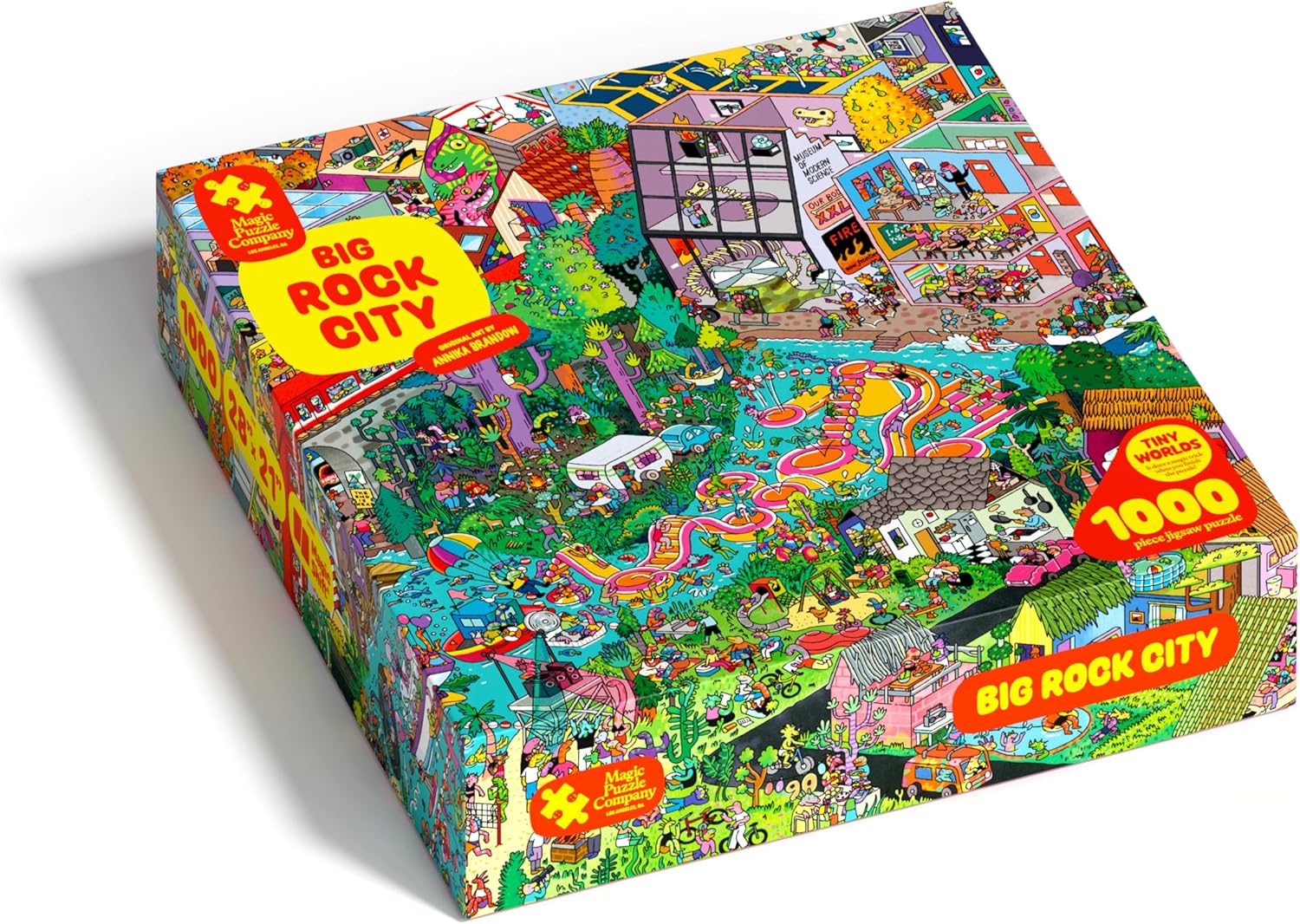
Magic Puzzle Company Big Rock City (Ages 15+) (opens Amazon in a new tab)
1,000-piece hand-illustrated puzzle with hidden details and a payoff twist at the end, explicitly human-drawn art, not AI-generated.
| Puzzle | Piece Count | Best For | Brand |
|---|---|---|---|
| Ravensburger Cozy Retreat | 500 (large format) | Relaxed pace, easier on the eyes | Ravensburger |
| Ravensburger Flower Shop | 1,000 | A solid default 1,000-piece | Ravensburger |
| Buffalo Games Cottage by the Sea | 1,000 | Budget-friendly alternative | Buffalo Games |
| Magic Puzzle Co. Big Rock City | 1,000 | A puzzle with a hidden twist | The Magic Puzzle Company |
Picking piece count and difficulty for an adult jigsaw
- 500 pieces: a single evening or a weekend, good for a first adult puzzle or a lower-pressure pick.
- 1,000 pieces: the standard adult format, usually a multi-day project done in sessions.
- A busier image (lots of small color variation) is harder at the same piece count than a simple landscape with big color blocks.
- Large-format puzzles keep a lower piece count but bigger individual pieces, a good option for reduced eye strain without cutting the challenge entirely.
Best Brain Teaser Puzzles and Logic Games
The best brain teasers keep working long after the first solve, either because they hold dozens or hundreds of possible challenges, or because they're genuinely hard enough that solving them once doesn't make the second attempt trivial. The picks below split into two real audiences: kids 6 and up through adults, and 2 harder options built more for a teen or adult who wants a genuine challenge.
What separates a real brain teaser from a one-and-done toy
- Multiple challenge levels or an open-ended number of solutions, not a single fixed answer.
- A difficulty rating you can trust: Hanayama's Mensa-rated line, for example, uses a real 1-to-6 scale.
- Portability, if it's meant for a car ride, waiting room, or travel bag rather than a table at home.
- A genuine age range on the box; a puzzle rated for young kids will bore a teen or adult in minutes.
Best Brain Teaser for Kids 7 and Up
A single-player logic game where 3D pieces fit a 2D outline shown on a card, with difficulty that scales from easy to genuinely hard. Small and flat enough for a car door or carry-on, which is most of why it's one of the most recommended travel brain teasers for this age.

Kanoodle Brain Teaser (Ages 7+) (opens Amazon in a new tab)
3D pieces fit a 2D card outline, difficulty scales from easy to hard, portable enough for travel.
Best Two-Player Brain Teaser
A dice-driven spatial puzzle with over 60,000 possible board layouts, so it doesn't get memorized and solved the way a fixed-answer puzzle does. It plays solo or head-to-head, and it's the only pick in this guide built as a genuine race between two players.

The Genius Square (Ages 6+) (opens Amazon in a new tab)
Dice-driven spatial puzzle with 60,000+ layouts, plays solo or head-to-head, award-winning game design.
Best Brain Teaser for a Serious Challenge
A precision-machined metal disentanglement puzzle from Hanayama's Mensa-rated line, rated Level 4 of 6 on their own scale. This is a real step up from the kid-friendly picks above, built for a teen or adult who wants a puzzle that's actually hard, not a shape sorter relabeled for grown-ups.

Hanayama Cylinder Puzzle (Ages 12+) (opens Amazon in a new tab)
Mensa-rated metal disentanglement puzzle, Level 4 of 6 difficulty, precision-machined for a real challenge.
Best Fidget-Adjacent Brain Teaser
An award-winning, patented magnetic cube that folds into more than 70 distinct shapes, so there's no single solved state to reach and stop at. It's less a puzzle to finish than an object to keep folding, which makes it a good gift-shelf pick alongside the more traditional brain teasers above.

Shashibo Shape-Shifting Cube (Ages 8+) (opens Amazon in a new tab)
Magnetic cube that folds into 70+ shapes, no single solved state, award-winning and patented design.
| Brain Teaser | Best Age | Format | Difficulty |
|---|---|---|---|
| Educational Insights Kanoodle | 7+ | 3D pieces, 2D card outlines | Easy to hard, scales up |
| The Genius Square | 6+ | Dice-driven spatial puzzle | 60,000+ layouts, 1 or 2 players |
| Bepuzzled Hanayama Cylinder | 12+ | Metal disentanglement | Level 4 of 6 (Mensa-rated) |
| Shashibo Shape-Shifting Cube | 8+ | Magnetic folding cube | Open-ended, no fixed solve |
Frequently Asked Questions
Frequently asked questions
What age is a wooden peg puzzle good for?
Peg puzzles work well from about 1 to 3 years old, since the single-piece-per-board format matches a toddler's early grip and shape-matching skill before they're ready for multi-piece puzzles. Always check the specific product's age range too.
Is a 180-piece puzzle safe for a toddler?
It's a better fit for a preschooler past the stage of mouthing toys, since the individual pieces are small. Supervise closely if a younger toddler is also in the room during play.
Are wooden puzzles actually more durable than cardboard ones?
Yes. Solid wood pieces hold up to being dropped, mouthed, and reassembled hundreds of times without the fraying or bending a cardboard puzzle eventually shows, which is exactly the kind of handling a toddler puzzle gets daily.
Why choose a floor puzzle over a regular table puzzle?
Larger finished size and bigger individual pieces make a floor puzzle easier for smaller hands and better suited to two kids working together, since there's enough room for both to reach different sections at once.
What's a good piece count for a first adult jigsaw puzzle?
500 pieces is the easiest realistic starting point: enough of a challenge to hold attention over a few sessions without the fatigue a 1,000-piece can bring on a first try. Move up to 1,000 once 500 starts feeling quick.
Does jigsaw puzzle finish quality actually matter?
Yes. A glossy finish reflects lamp and overhead light, which makes it harder to see piece edges and colors accurately, especially at night. An anti-glare or matte finish, like Ravensburger uses, is worth paying for if you puzzle regularly.
What age is a good starting point for brain teaser puzzles?
Around 6 to 7 years old for portable logic games like Kanoodle or The Genius Square, which both scale in difficulty. Save harder metal disentanglement puzzles, like Hanayama's Mensa-rated line, for a teen or adult.
What does a Mensa rating actually mean for a puzzle?
Hanayama rates its puzzles on a 1-to-6 difficulty scale reviewed by Mensa, so a Level 4 puzzle is a genuine, verified step up in difficulty from a Level 1 or 2, not just marketing language.
What's the difference between a brain teaser and a jigsaw puzzle?
A jigsaw puzzle has one fixed picture and one way to finish it. A brain teaser usually has multiple challenge levels, an open-ended number of solutions, or a genuinely hard single mechanism, meant to be picked back up more than once.
Do puzzles actually help child development?
Matching shapes and working out where a piece fits builds fine motor skills, hand-eye coordination, and early problem-solving, the same skills that carry over into writing and building activities. It's genuine practice, not just quiet time.